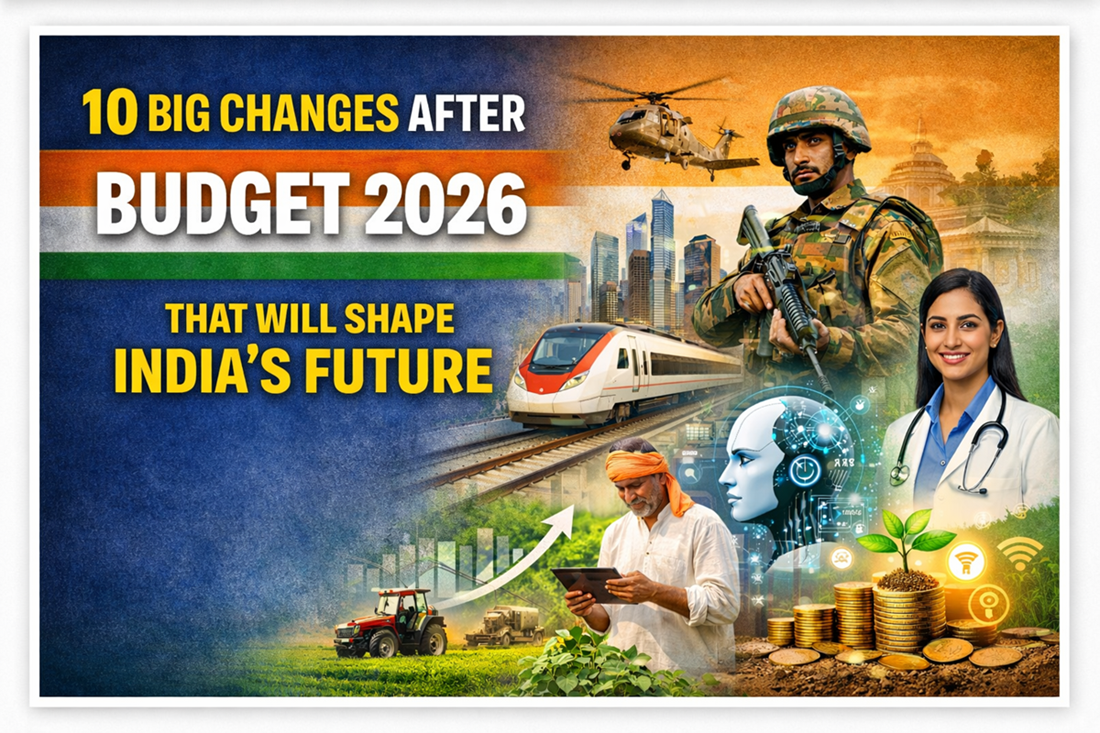
10 Big Changes After Budget 2026 That Will Shape India’s Future
The Union Budget 2026 presents a strategic roadmap focused on fiscal consolidation, high-capital expenditure, and long-term economic resilience. Rather than relying on short-term populism, Budget 2026 prioritizes infrastructure modernization, digital public infrastructure (DPI), technological innovation, and targeted support for middle-class taxpayers and small businesses.
Here is a detailed breakdown of the 10 major policy changes, budget allocations, and reforms introduced in Union Budget 2026 and how they directly impact citizens, investors, and businesses.
1. Record Capital Expenditure (Capex) Allocation
Continuing its strategy of infrastructure-led growth, the government increased the Capital Expenditure outlay to a record high of ₹11.11 Lakh Crore (approx. 3.4% of GDP).
-
Highways & Freight Corridors: Expansion of the PM Gati Shakti National Master Plan and dedicated freight corridors to cut logistics costs below 8% of GDP.
-
Railways: Modernization of 1,000+ stations and accelerated deployment of the Kavach safety system across high-density rail corridors.
2. Personal Income Tax Slab Adjustments & Relief
To increase disposable income for middle-income earners, key revisions were introduced under the New Tax Regime:
-
Standard Deduction: Increased to ₹75,000 for salaried employees and pensioners.
-
Slab Rationalization: The tax-free income limit effectively stands up to ₹7 Lakhs, providing direct relief to entry-level professionals and middle-class households.
3. Dedicated AI & DeepTech Mission
Expanding on earlier technology initiatives, Budget 2026 officially launched the National DeepTech & AI Innovation Mission backed by a corpus fund.
-
Sector Integration: Grants for AI research applied directly to precision agriculture, diagnostic healthcare, and fraud prevention in fintech.
-
Compute Infrastructure: Subsidies for setting up domestic graphics processing unit (GPU) clusters to reduce reliance on foreign cloud servers.
4. Enhanced Credit Guarantees for MSMEs
Recognizing small businesses as the primary engine of employment, the budget introduced enhanced financial safety nets:
-
Self-Financed Guarantee Fund: Up to ₹100 Crore credit guarantee cover for manufacturing MSMEs buying machinery and equipment without collateral.
-
TReDS Integration: Mandatory onboarding of major public sector enterprises on trade receivables platforms to eliminate delayed payments to small vendors.
5. Education, Skilling, and Industry Apprenticeships
To address the skill mismatch in modern manufacturing and tech sectors, Budget 2026 introduced direct financial incentives:
-
PM Internship Scheme: Stipend support and one-time assistance for top 500 corporate internships benefiting 1 crore youth over 5 years.
-
Skill Hubs: Modernization of 1,000 Industrial Training Institutes (ITIs) aligned with Industry 4.0 standards (Robotics, IoT, and Cyber-Physical Systems).
6. Agri-Tech Infrastructure & Climate-Resilient Crops
Agriculture policy shifted sharply toward tech integration and climate resilience:
-
Digital Public Infrastructure for Agri: Rollout of digital crop surveys, digital land records, and localized AI advisory networks across rural districts.
-
Natural Farming & Bio-Inputs: Establishment of 10,000 bio-input resource centers to encourage eco-friendly farming practices.
7. Expanded Healthcare & Local Pharma Manufacturing
The healthcare budget prioritizes domestic self-reliance and expanded coverage:
-
Ayushman Bharat Expansion: Coverage extended to senior citizens aged 70 and above, regardless of income bracket.
-
PLI Scheme for Active Pharmaceutical Ingredients (APIs): Additional financial outlays to boost domestic manufacturing of critical active pharmaceutical raw materials and reduce import dependency.
8. Higher Defence Outlay with Emphasis on R&D
National security spending saw a steady increase, with a structural shift toward domestic procurement:
-
Capital Acquisition: Over 75% of the defence capital procurement budget is reserved strictly for domestic contractors under Atmanirbhar Bharat.
-
Private Sector R&D: Allocation of dedicated funds to encourage startups and private firms to design and manufacture defence hardware locally.
9. Sustainable Tourism & Heritage Circuit Grants
Tourism has been repositioned as a top service-sector employment generator:
-
Destination Development: Interest-free long-term loans to state governments to develop key spiritual and heritage sites up to global standards.
-
Ecotourism Incentives: Frameworks to develop eco-tourism projects along coastal areas and forest reserves with community participation.
10. Next-Gen Banking Access & Digital Public Infrastructure
To bridge the urban-rural financial divide, Budget 2026 expanded the reach of digital banking:
-
Rural Digital Banking Units (DBUs): Accelerated setup of DBUs across tier-3 to tier-6 towns.
-
PM Jan Dhan 2.0: Enhanced insurance cover and higher micro-credit limits linked to Jan Dhan accounts to foster formal credit access.
Economic Outlook and Policy Takeaways
Union Budget 2026 balances fiscal discipline with targeted development spending. By prioritizing capital expenditure, digital public infrastructure, and domestic manufacturing, the government aims to keep India’s GDP growth trajectory strong while maintaining fiscal deficit targets.
Key Takeaways for Readers:
-
Taxpayers: Additional savings via updated slabs and higher standard deductions.
-
Investors & Businesses: Increased opportunity in infrastructure, defence manufacturing, clean energy, and AI technologies.
-
Youth & Job Seekers: Enhanced internship schemes and modernized vocational training to improve employability.